
Julius Rodriguez at Jazz Forum Arts
Wandering Nomads should always keep their ears close to the ground.
Not every signal arrives through old theaters, psychedelic parking lots, or amplified arenas carrying decades of accumulated mythology. Some of the strongest wandering environments emerge quietly inside intimate listening rooms where improvisation, openness, and attention itself become the center of gravity.
On February 6, 2026, travelers gathered inside Jazz Forum Arts for two sold-out performances by Julius Rodriguez and his quartet featuring vocalist Ekep Nkwelle alongside Brandon Rose on bass and Joshua Watkins on drums.
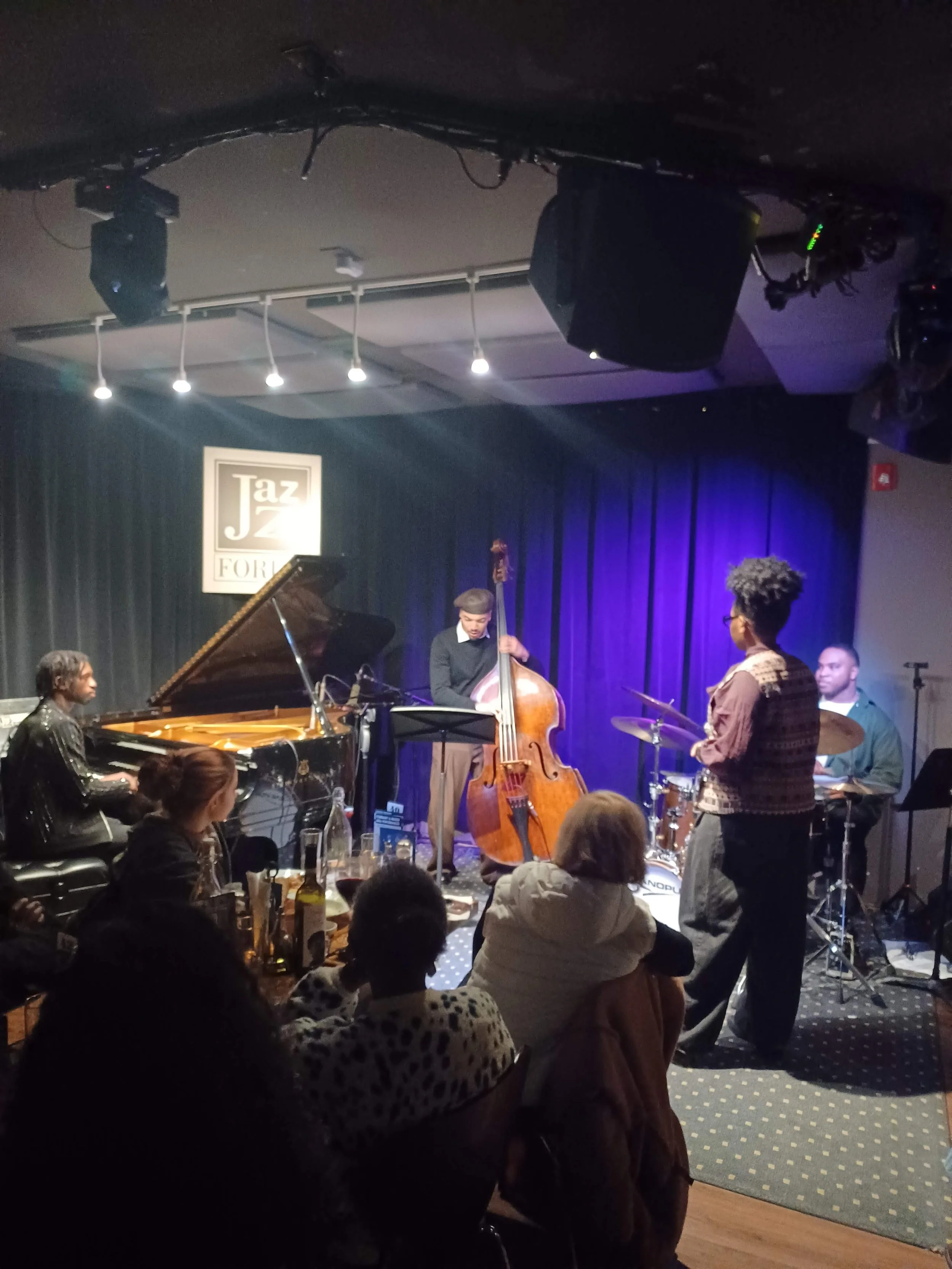
Manifestations of joy at Jazz Forum Arts. Pharoah Sanders tunes a definite highlite for me
Jazz Forum Arts is one of those rare places that still feels genuinely devoted to listening.
The room itself carries unusual warmth — intimate without feeling crowded, elegant without becoming sterile, serious about music without becoming self-important. Good cocktails. Good food. Soft lighting. Clear sound. A listening environment designed to let improvisation breathe naturally without distraction.
And at the center of it all is Mark Morganelli.
Morganelli is not only an exceptional trumpeter with decades of history across the jazz world, but also one of those increasingly rare cultural caretakers who understands that scenes do not sustain themselves automatically. Spaces like Jazz Forum Arts survive because people intentionally create environments where musicians, listeners, travelers, and younger observers can continue encountering living music together in real time.
That generosity is visible the moment you walk through the door.
The venue sits in beautiful Tarrytown along the Hudson River corridor — an area filled with old architecture, riverfront wandering, cafés, bookstores, trails, small restaurants, music rooms, and strange little pockets of layered history stretching through the lower Hudson Valley. It is the kind of place wandering Nomads should spend more time exploring.
Especially at night.
Especially with music nearby.
Julius Rodriguez carried enormous creative energy throughout the evening, moving fluidly between jazz vocabulary, groove structures, rhythmic experimentation, gospel textures, and moments that felt almost impossibly modern while still deeply rooted in older musical traditions. There is something unusually open about the way he approaches improvisation — less concerned with preserving genre boundaries than with allowing emotional movement to travel freely between them.
Ekep Nkwelle’s voice added remarkable depth and atmosphere throughout the performance. Warm, grounded, emotionally expansive, and quietly fearless, her phrasing carried the room effortlessly while Brandon Rose and Joshua Watkins maintained a rhythmic foundation that remained simultaneously subtle and alive beneath the surface of the entire evening.
At several points the listening room became so still that even the smallest musical gestures seemed to reshape the atmosphere physically.
Observers leaned forward unconsciously.
Conversations disappeared completely.
Glasses stopped moving.
The room listened.
Improvisational jazz environments function differently from most modern entertainment systems.
They require openness.
Patience.
Attention.
Trust in emergence rather than prediction.
And when the signal fully connects, listeners often leave carrying something difficult to describe yet immediately recognizable to other wandering travelers:
expanded perception,
renewed curiosity,
and the reminder that reality remains far larger, stranger, and more improvisational than consensus systems usually encourage us to believe.
Nomads should always remain open to unfamiliar sounds.
The next signal rarely arrives exactly where you expect it.
There are no accidents.
May all beings benefit.
Continue Wandering:
https://nikkiarcane.com/search?q=wandering
https://nikkiarcane.com/search?q=signal
https://nikkiarcane.com/search?q=reality+drift
https://nikkiarcane.com/search?q=acidcat
