
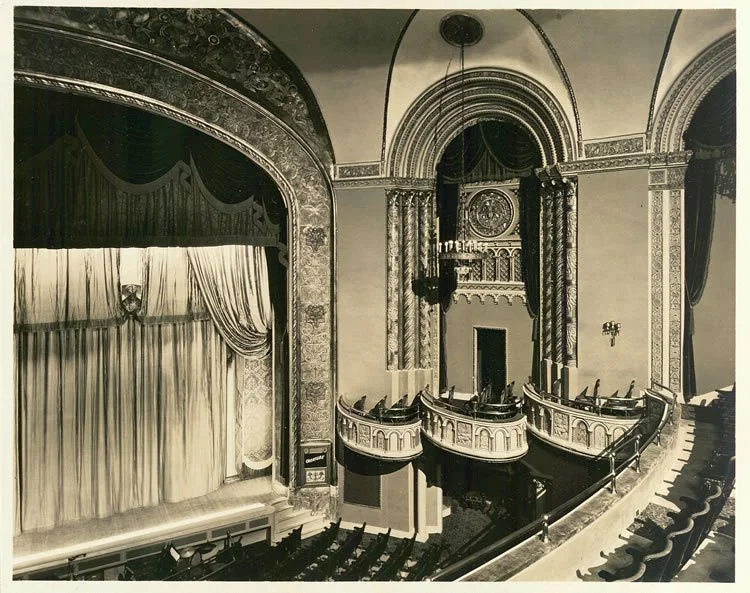
The Capitol Theater
It All Begins Here
A Fracture in reality that refused to closeSome buildings become old.
Some buildings become historic.
A few become something stranger.
The Capitol Theatre in Port Chester, New York feels less like a venue and more like a continuity system—an improbable structure that has survived multiple realities while somehow remaining itself.
For nearly a century, travelers have arrived here carrying vastly different expectations. Moviegoers in the 1920s. Rock and roll pilgrims in the 1970s. Deadheads. Theater patrons. Phish fans. Phil Lesh devotees. JRAD travelers. Wandering Nomads.
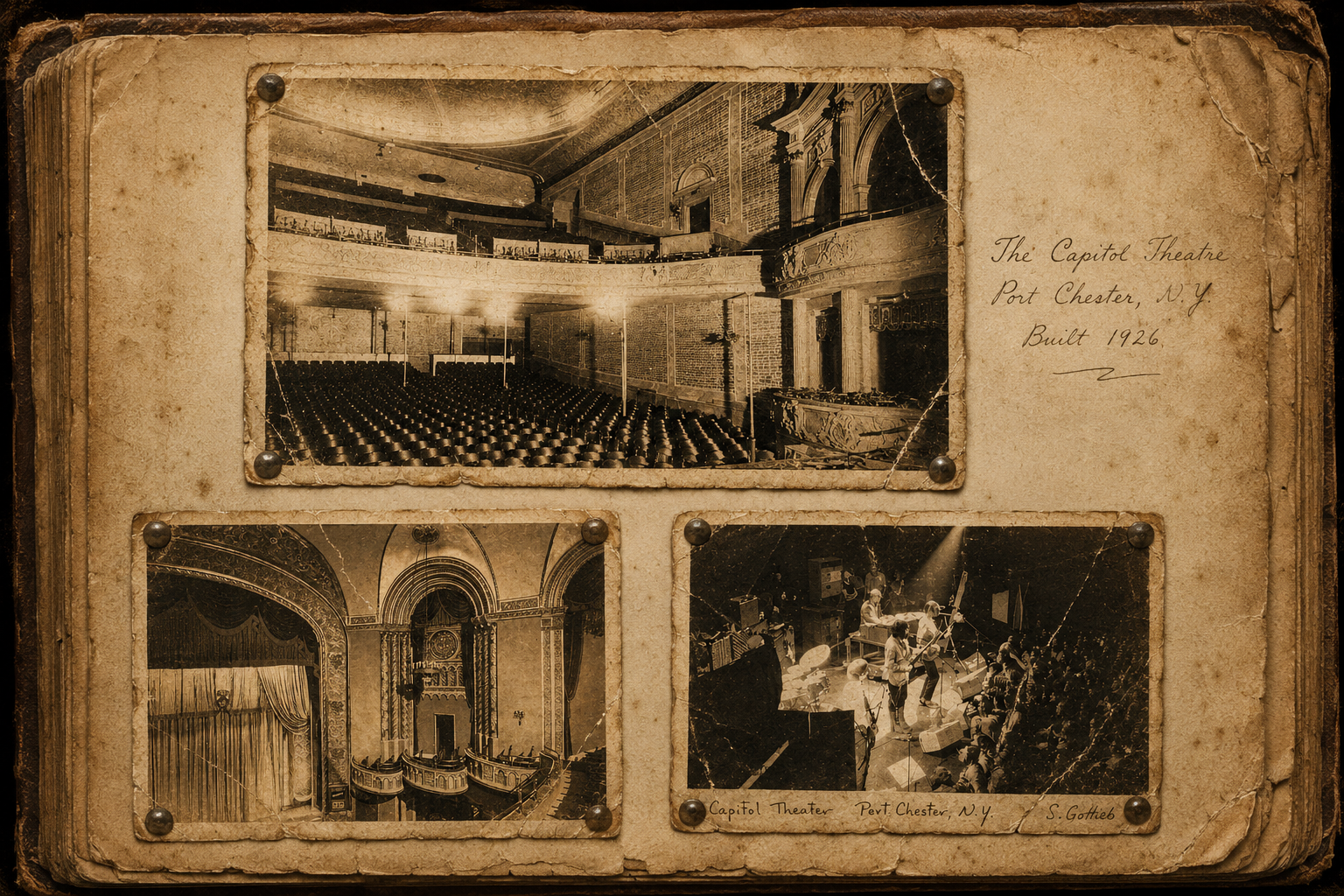
Recovered photographs from the Capitol Theatre archive in Port Chester, New York — a wandering continuity structure built in 1926 and still transmitting signals across layered realities nearly a century later. The theater has hosted vaudeville, film, the Grateful Dead, Phil Lesh, JRAD, and generations of wandering Nomads passing through its ornate halls while reality briefly loosened around them.
The faces change.
The building remains.
Or perhaps more accurately, the building continues changing while somehow remaining recognizable.
Reality spends most of its time pretending to be stable.
The Capitol Theatre is one of the places where that illusion occasionally slips.
A Palace for Dreams
The Capitol opened on August 18, 1926, designed by legendary theater architect Thomas W. Lamb, one of the great architects of the American movie palace era. Lamb designed more than one hundred theaters across North America, creating spaces intended to transport ordinary people into extraordinary worlds.
At the time, motion pictures were still a relatively new form of mass enchantment.
The Capitol was built as a grand playhouse of decorative beauty and luxurious comfort. Local advertisements proudly promoted what was described as the only theater refrigeration system in Westchester County. Opening night sold out all two thousand seats and turned hundreds away.
People came seeking entertainment.
What they received was a place designed specifically to suspend ordinary reality for a few hours.
In that sense, the theater has never stopped performing its original function.
The Rock Palace Emerges
By the late 1960s, consensus reality had become increasingly difficult to maintain.
The movies faded.
Music arrived.
The Capitol transformed into what many still regard as one of the most important rock venues in America. Under promoter Howard Stein, the theater hosted artists including Janis Joplin, Pink Floyd, Traffic, Jefferson Airplane, Hot Tuna, and the Grateful Dead.
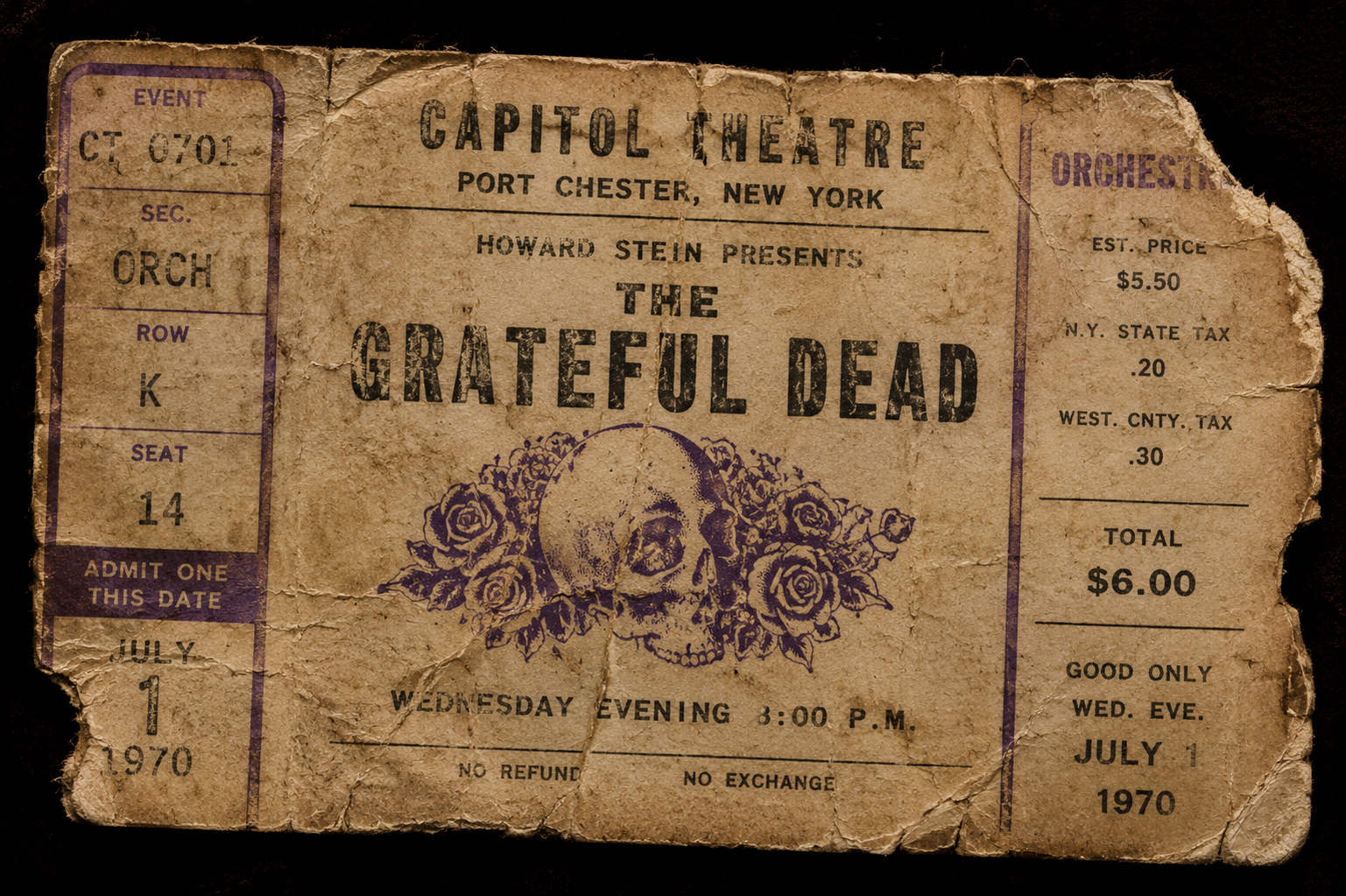
Antique Grateful Dead ticket stub from a historic Capitol Theatre performance in Port Chester, New York. The heavily distressed paper ticket features sepia aging, torn edges, deep creases, faded typography, and weathered archival textures. The design references the theater’s early rock era and wandering Deadhead culture, appearing like a recovered artifact rediscovered within an old box of photographs and forgotten concert memories.
Janis Joplin famously debuted "Mercedes Benz" after writing it at a nearby Port Chester bar.
Pink Floyd passed through while still exploring the outer boundaries of sound.
Traffic arrived.
Hot Tuna arrived.
The Grateful Dead arrived and something unusual happened.
The relationship between the Dead and The Capitol became one of those strange feedback loops that occasionally emerge between artists and places.
Between 1970 and 1971, the Grateful Dead performed a legendary run of shows at The Cap that remain deeply embedded within Deadhead culture. Some fans consider them among the finest performances of the era. Jerry Garcia himself once remarked that only two venues in the country were truly configured properly for music: Fillmore East and The Capitol Theatre.
These performances continue reverberating decades later.
Not metaphorically.
Actually.
You can still feel them.
The Dark Years
Then, as happens with all things, impermanence arrived.
A village ordinance restricting late-night entertainment contributed to the collapse of the theater's rock era. The lights went out. The roof deteriorated. Pigeons took up residence on the stage. For years the building drifted toward ruin.
Many structures disappear during this phase.
The Capitol did not.
This feels important.
Nikki Dharma often returns to the reality that all compounded things eventually change, decay, and dissolve. Yet impermanence does not necessarily imply disappearance.
Sometimes it means transformation.
The Capitol became something else.
Then something else again.
And eventually something else after that.
Like wandering itself, the destination was never fixed.
Shapiro and the Ghost
Every old theater accumulates stories.
The Capitol is no exception.
Among the most enduring is the story of a resident spirit often referred to as "Shapiro's Ghost."
Accounts vary depending upon who is telling the story. Employees, musicians, staff, and visitors have occasionally reported unexplained footsteps, movement, sounds, or the feeling that the theater remains occupied after everyone has gone home.
Whether one believes in ghosts is ultimately irrelevant.
What matters is that places accumulate memory.
Theaters are especially good at it.
Thousands of performances.
Millions of emotions.
Laughter.
Grief.
Celebration.
Longing.
Hope.
Regret.
Expectation.
For nearly one hundred years, all of that has flowed through this building.
If some residue remains behind, would that really be surprising?
The signal changes depending on who encounters it.
Rebirth
In 2012, music entrepreneur Peter Shapiro restored and reopened The Capitol after extensive renovations. Bob Dylan played the reopening performance. Garcia's, the adjacent bar named with the blessing of Jerry Garcia's family, became part of the growing ecosystem surrounding the theater.
Since then, The Capitol has entered yet another life.
Phil Lesh effectively adopted the theater as one of his spiritual homes, performing there more than one hundred times after its reopening. The connection became so profound that Port Chester eventually dedicated "Phil Lesh Lane" beside the venue.
The building continues gathering stories.
Modern Continuity
Today, JRAD frequently appears within the Capitol's orbit.
The relationship feels natural.
Improvisational music thrives in spaces that encourage risk, listening, and collective attention.
The Capitol was built for exactly that.
Not because Thomas Lamb anticipated jam bands in 1926.
But because great architecture often survives by remaining adaptable enough to host realities its creators never imagined.
That may be the theater's greatest trick.
Every generation believes it has discovered The Capitol.
In truth, The Capitol has been patiently waiting for them all along.
A Fracture That Remains Open
Some places become landmarks.
Some become destinations.
A rare few become portals—not to somewhere else, but to deeper layers of the place you already are.
The Capitol Theatre is one of those places.
The building has survived cinema, vaudeville, rock and roll, abandonment, decay, resurrection, and nearly a century of human gathering.
It continues standing in Port Chester as a reminder that continuity does not require permanence.
The map functions perfectly until reality stops honoring it.
The Capitol Theatre has spent almost one hundred years proving that some realities are larger than the maps we create for them.
These artifacts are not answers.
They are signposts.
And few signposts have guided more wandering travelers than The Capitol Theatre.